Nonpolar Capacitor
Definition
A nonpolar capacitor has no polarity distinction between its terminals and can be connected in either direction. It is also referred to as a bipolar capacitor.
Film capacitors and ceramic capacitors are nonpolar due to their inherently nonpolar structures.
Although standard aluminum electrolytic capacitors are polarized, there are also types with modified electrode structures that eliminate polarity. These are known as nonpolar electrolytic capacitors (bipolar electrolytic capacitors).
Explanation
The anode aluminum foil undergoes an etching process to roughen the surface and a forming process to create the oxide film that serves as the dielectric, while the cathode aluminum foil is etched but does not undergo the forming process. As a result, its withstand voltage is only about 0.5 V. This asymmetrical structure determines the capacitor’s polarity, and applying voltage in the reverse direction causes the cathode side to exceed its withstand voltage, leading to breakdown.
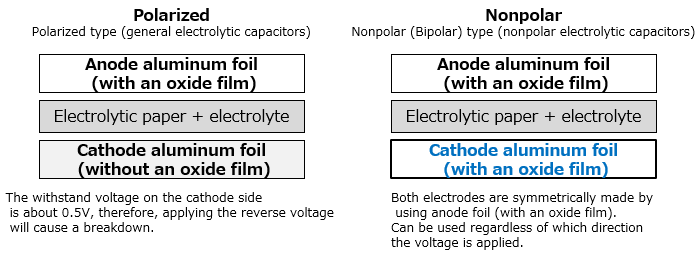
Nonpolar electrolytic capacitors eliminate this asymmetry by using anode foil for both electrode sides. Because formed foil with an oxide film is used on both sides, the structure becomes symmetrical and can be used regardless of the direction in which voltage is applied. However, achieving the same capacitance requires a larger foil area, resulting in a larger volume than a polarized capacitor.
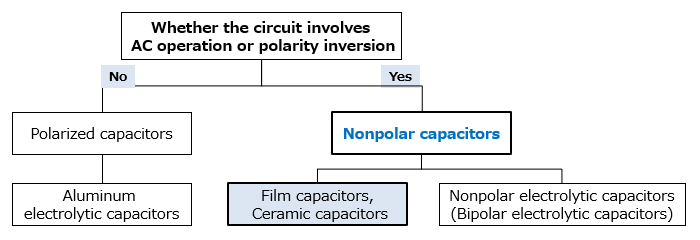
Nonpolar capacitors are required in circuit sections where the voltage across the capacitor does not remain constant. Examples include circuits carrying AC current, circuits in which the voltage polarity may reverse during power‑on or power‑off transients, and AC circuits such as speaker crossover networks.
Using a polarized capacitor in these circuits may cause characteristic degradation and eventual breakdown due to the reverse voltage applied to the capacitor. Therefore, designers should first confirm whether the voltage polarity across the capacitor remains constant.
When a nonpolar capacitor is required, film capacitors and ceramic capacitors are suitable options because they are inherently nonpolar.
Film capacitors offer high withstand voltage and low loss, making them suitable for high‑voltage AC circuits and noise suppression applications. When large capacitance values of several tens of microfarads or more are required and film or ceramic capacitors become impractical in size, nonpolar electrolytic capacitors become a viable option. In all cases, capacitors should be selected after confirming the required capacitance and the voltage applied in the circuit being designed.
The considerations for capacitance, withstand voltage, and related selection criteria are explained in the related articles.