History of Capacitors and How to Select Them (Part 1)
2025-5-26

- Panasonic's Electrolytic Capacitors and Conductive Polymer Electrolytic Capacitors
- Evolution of Electrolytic Capacitors to Conductive Polymer Electrolytic Capacitors and Their Applications
- Emergence of Electrolytic Capacitors (Before the 1970s)
- Spread of Electrolytic Capacitors (1980s)
- Spread of Conductive Polymer Electrolytic Capacitors (1990s)
- Spread of Low Profile Chip Type Conductive Polymer Electrolytic Capacitors (2000s)
- Increase in Demand for Conductive Polymer Electrolytic Capacitors (2010s)
- Summary
- Product Information Related to This Article
- Related Articles
- Tags Related to This Article
This article explains the characteristics and usage of general electrolytic capacitors and conductive polymer electrolytic capacitors sold by Panasonic Industry while reviewing their origin as well as the reasons for adopting them in major devices.
1. Panasonic's General Electrolytic Capacitors and Conductive Polymer Electrolytic Capacitors
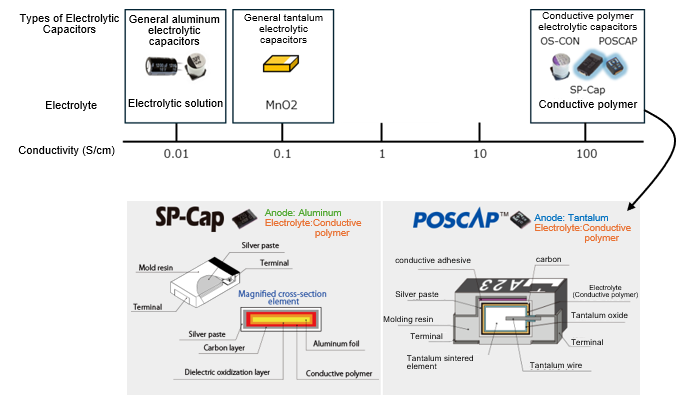
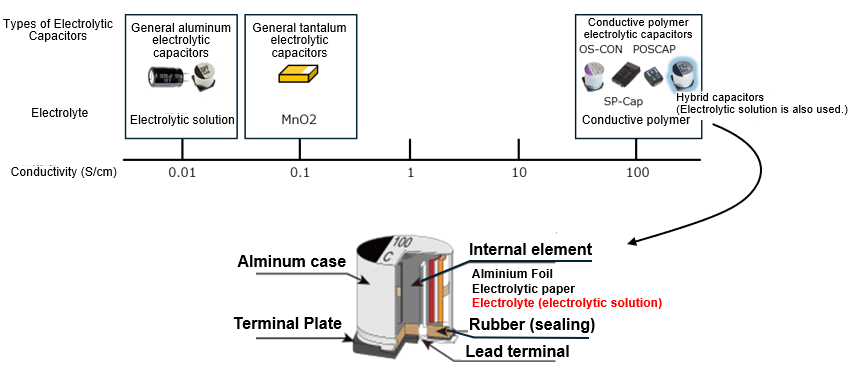
First, let's briefly review the classification of capacitors. As shown in the figure below, one of the most basic types of capacitors is general aluminum and tantalum electrolytic capacitors. Conductive polymer electrolytic capacitors were developed as an evolved version of general electrolytic capacitors.
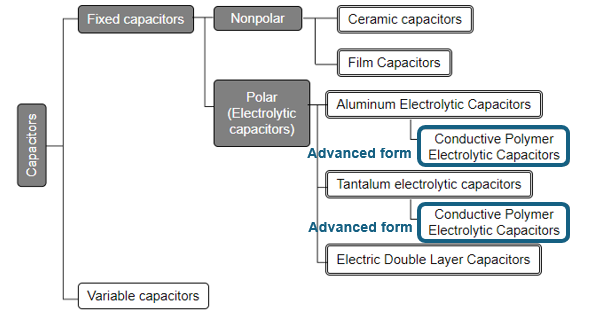
Regarding general electrolytic capacitors and conductive polymer electrolytic capacitors, Panasonic Industry offers the following five products, which are mainly small, surface-mount products.
- General aluminum electrolytic capacitors (wound type)
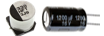
- Conductive polymer aluminum electrolytic capacitors (wound type) (OS-CON)

- onductive polymer aluminum electrolytic capacitors (chip type) (SP-Cap)

- Conductive polymer hybrid aluminum electrolytic capacitors (wound type)

- Conductive polymer tantalum capacitors (chip type) (POSCAP)

In order to deepen your understanding of the characteristics and usage of each product, we will explain them based on the development history of products and applications.
2. Evolution of General Electrolytic Capacitors to Conductive Polymer Electrolytic Capacitors and Their Applications
2-1. Emergence of Electrolytic Capacitors (Before the 1970s)
Commercial mass production of electrolytic capacitors began in the 1930s, and since then, their capacity has been increased. Various types of know-how have been used to increase their capacity. As the main methods to increase the surface area of the dielectric that stores electricity, the etching of aluminum foil has been reduced for aluminum electrolytic capacitors and the size of tantalum powders has been reduced for tantalum electrolytic capacitors. As a result of the increase in capacity, the product has become more compact. Panasonic has been mass-producing aluminum electrolytic capacitors since 1970.
2-2. Spread of General Electrolytic Capacitors (1980s)
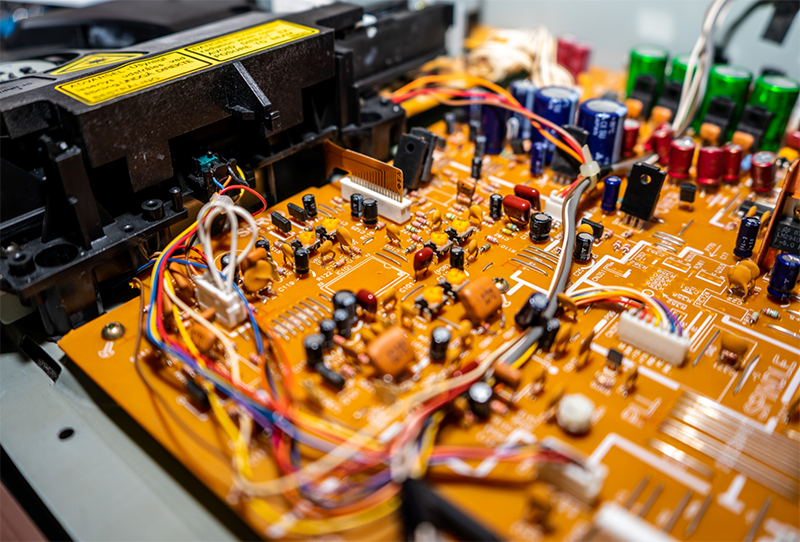
Electrolytic capacitors have established themselves as a common type of capacitor and have been used in various electronic devices. The reason for adopting them is that it is easier to obtain a large capacity than other types of capacitors in many cases. In the 1980s, audiovisual devices such as VCRs, CD players, and home game consoles became popular. Many small-size general electrolytic capacitors were used in these devices.
2-3. Spread of Conductive Polymer Electrolytic Capacitors (1990s)
In the 1990s, the audiovisual devices that became popular in the 1980s evolved into higher performance devices such as DVD players, MD players, and new types of home game consoles. In addition, from the late 1990s, PCs became popular with the release of Windows 95. The high-performance semiconductors used in these devices required stricter power supply stabilization due to the decrease in operating voltage caused by circuit miniaturization.
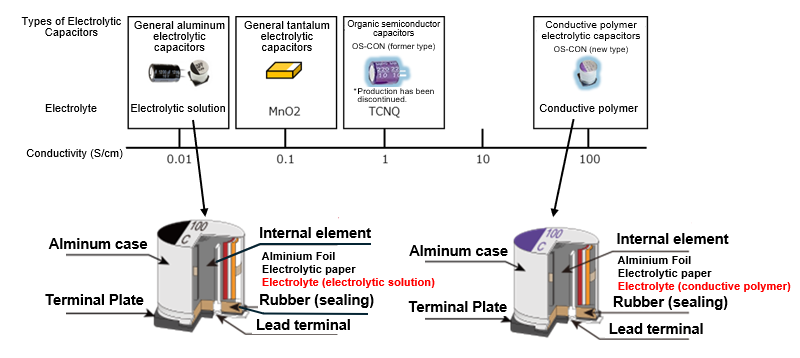
During the period, organic semiconductor capacitors, which are an evolved version of general electrolytic capacitors, were becoming more popular as they could effectively solve this problem. This type of capacitors was first mass-produced by SANYO Electric (now Panasonic) in 1983 under the name "OS-CON". They later transitioned to conductive polymer electrolytic capacitors in 1999 by material improvements. These capacitors provide the high capacity equivalent to conventional general electrolytic capacitors while achieving low internal resistance (low ESR). Thus, they achieve a stable power supply with fewer number of parts, offering an option for achieving higher performance and smaller devices. At the same time, they provide the advantage of solid electrolytic to improve the reliability of devices.
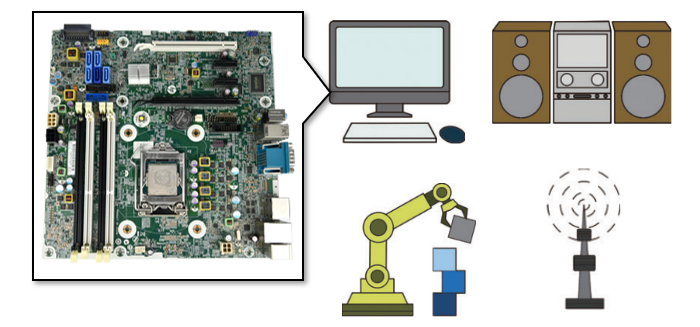
For example, many general electrolytic capacitors used in early desktop PCs were replaced by OS-CON gradually. This is because general electrolytic capacitors increased the number of parts and caused frequent leakage of liquid in some products as the current and heat generation increased due to higher-performance CPUs. As these excellent characteristics and reliability of OS-CON were recognized, it was used in a wider range of applications such as industrial and communication devices.
2-4. Spread of Low Profile Chip Type Conductive Polymer Electrolytic Capacitors (2000s)
In the 2000s, the evolution of audiovisual devices such as BD players, MP3 players, high-performance home game consoles, and flat-screen TVs continued to advance. However, the center of interest in electronics during this period was the evolution of PCs. This is because PCs have the versatility equivalent to audiovisual devices to enjoy videos, music, and games and they can be used to access a huge amount of content by connecting to the Internet. In order to take full advantage of this convenience, the demand for carrying PCs at work and at home grew, and in the 2000s, the demand for laptops overtook that for desktop PCs.
Naturally, consumers prefer thinner and lighter laptops. OS-CON was commonly used in conventional desktop PCs, but its height was a problem for many laptops. On the other hand, conventional general tantalum electrolytic capacitors met requirements for parts height as there are low profile products. However, they were not considered as an option because their ESR is high and they were known for accidental ignition defects that occur due to the inclusion of oxygen in the materials. Under these circumstances, low profile, chip type conductive polymer electrolytic capacitors, which have been mass-produced since the 1990s, solved the problem and were widely adopted. The world's first mass-produced product was Panasonic's "SP-Cap," whose mass production started in 1990. After that, SANYO Electric (now Panasonic) mass-produced "POSCAP" as a similar low profile, chip type product from 1997.
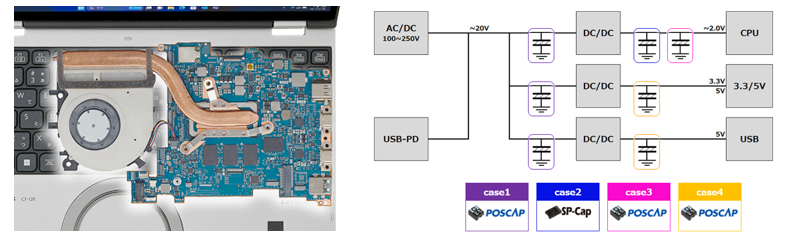
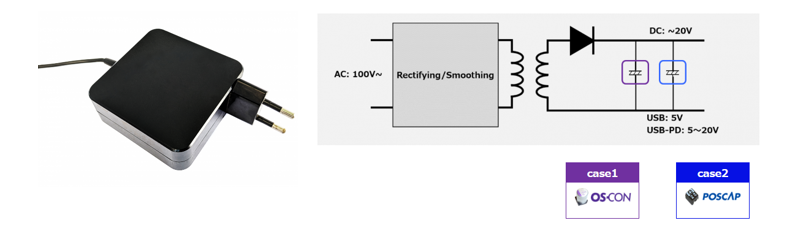
Although their applications overlap, there are subtle differences, so they are used differently depending on the location and purpose of use. SP-Cap is used to stabilize the power output voltage particularly to high-current processors due to its low ESR achieved by its laminated aluminum structure. On the other hand, POSCAP demonstrates high volumetric density achieved by tantalum powder technology and sintered body structure, and it can satisfy requirements for small size and high pressure resistance, making it especially suitable for small devices with strict mounting area and height limits as well as power inputs and outputs.
2-5. Increase in Demand for Conductive Polymer Electrolytic Capacitors (2010s)
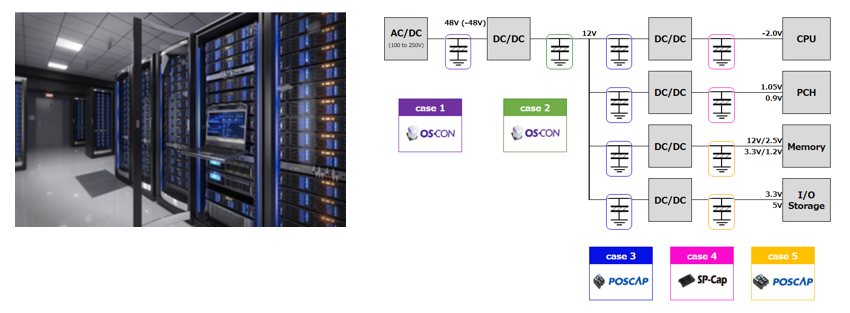
PCs continued to be in demand as high-performance tools for information processing at work and in personal life. However in the 2010s, smartphones, which are more convenient to use, became commonplace as the main information communication device. Mobile phones, the predecessor of smartphones, have existed since the 1980s. Although they have become more popular as they became smaller, they were not as versatile as PCs. In the 2010s however, as communication networks developed and performance of smartphones improved, they became a device that could be used to enjoy videos, games, and social media. They quickly became commonplace as they are more portable and more convenient in terms of power supply than PCs. However, the convenience of smartphones is not achieved by the device alone, and many applications and services need to connect to servers in the cloud and storage devices. Base stations and communication devices to connect the cloud and smartphones are also required. These devices have come to use higher-performance processors every year to cope with the rapid increase in communication and information volume due to the explosive spread of smartphones. As they operate at higher temperatures than PCs and smartphones, capacitors are required to have high reliability and capacity to stabilize the power supply. Therefore, conductive polymer electrolytic capacitors such as SP-Cap, POSCAP, and OS-CON have become the standard choice instead of general electrolytic capacitors.
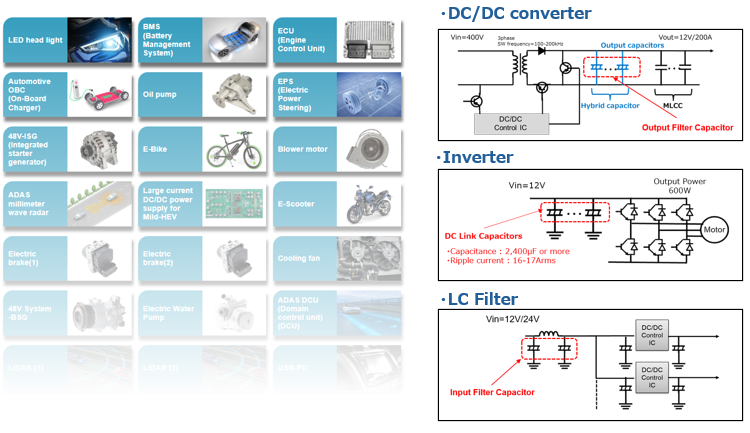
The 2010s was also a period when the usefulness of conductive polymer electrolytic capacitors was expanded to various automotive devices. The background of this was the progress of electrification aimed at higher fuel efficiency and safety as well as environmental conservation. Starting with the replacement of hydraulic and mechanical control systems, the number of electronic circuits installed in automobiles has increased due to the progress of transitioning to xEVs equipped with batteries and motors as driving power and the installation of ADAS (advanced driver assistance systems). In this situation, there was a need to reduce the size and number of general electrolytic capacitors that were previously used in order to meet the mounting size and weight requirements. As more electronic circuits are used, measures for high currents are required. Automotive devices also require measures to save battery consumption as well as safety measures to prevent short circuits. In response to this demand, Panasonic began mass production of hybrid capacitors, which are a fusion of conductive polymer electrolytic capacitors and general electrolytic capacitors, in 2012. In hybrid capacitors, both low ESR and low leakage current (high insulation repairability) were achieved by retaining both conductive solid electrolyte and liquid electrolyte. As a result, they satisfied the aforementioned requirements and started to be adopted in LC filters, DC/DC converters, and inverters in various automotive devices. In addition, just like conventional conductive polymer electrolytic capacitors, they have been adopted in industrial equipment as well as information communication infrastructure.
3. Summary
In response to the demand for advanced devices in each era, Panasonic has developed diversified conductive polymer electrolytic capacitors, which are evolved versions of general electrolytic capacitors, and has expanded the fields where they are used as well as their applications. In the next article, we will touch on the trends in cutting-edge electronic devices that support the evolution of society in the recent 2020s and explain the key points for using our capacitors introduced so far.4. Product Information Related to This Article
5. Related Articles
6. Tags related to this article
 Search by Category
 Search by Keyword
 Search by Product