Processor Basics (1) - Overview and Trends -
2026-10-28

1. What Is a Processor?
A processor is a semiconductor device manufactured using semiconductive materials, which can act as both a conductor and an insulator depending on conditions. Among semiconductor devices, a processor belongs to IC (Integrated Circuit) consisting of a vast number of highly miniaturized circuits.
Processors are installed in a wide variety of equipment and systems. By performing an enormous amount of computational processing, they enable numerous functions and applications.
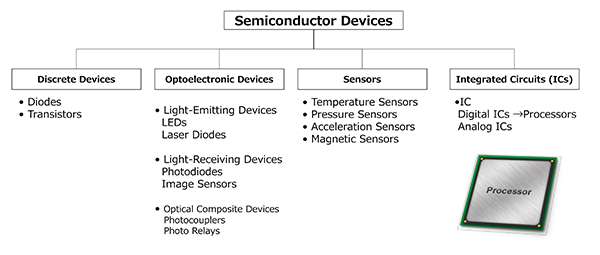
One of the most well-known and useful examples of processors is the CPU (or SoC) used in personal computers and smartphones. All applications, including video streaming, social networking services, and games, are realized through the computational processing performed by processors.
Processors are often regarded as the "brains" of electronic products. Since users expect increasingly comfortable and responsive experiences, improvements in processor performance have become one of the most important factors in electronic product specifications.

2. Processor Performance Improvement
How has processor performance improved over the years? One of the major factors often discussed is circuit miniaturization. Inside a processor are an enormous number of microscopic transistors. A transistor is the smallest unit of a computing circuit. Higher computational performance can be achieved with the increased number of transistors, by combining transistors appropriately to form logic circuits.
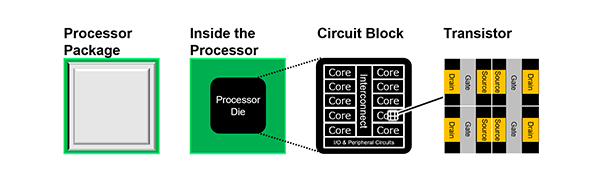
Circuit miniaturization means reducing the size of individual transistors, thereby allowing a greater number of transistors to be integrated into a processor. This trend was famously described by Moore's Law, proposed in 1965, which stated that the number of transistors in a processor would double approximately every 2 years due to advances in manufacturing technology.
In fact, advances in semiconductor fabrication technology drove a dramatic increase in transistor count. While processors in the early 1970s contained only a few thousand transistors, today's advanced processors may contain hundreds of billions of transistors.

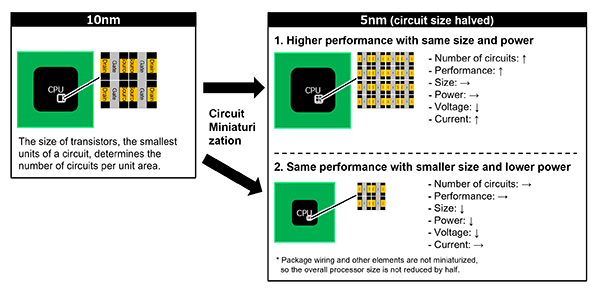
There are two primary ways to leverage the benefits of circuit miniaturization:
- Higher Performance
When targeting higher performance, miniaturization enables improvements in computational capability while maintaining similar size and power consumption.
Performance Improvement = Increased Circuit Count (Higher Current) × Circuit Miniaturization (Smaller Circuit Size and Lower Operating Voltage)
→ Equivalent Size, Similar Power Consumption - Smaller Size and Lower Power Consumption
When the same processing performance is sufficient, miniaturization can reduce both device size and power consumption.
Equivalent Performance = Similar Circuit Count × Circuit Miniaturization (Smaller Circuit Size and Lower Operating Voltage)
→ Reduced Size, Reduced Power Consumption
However, even if miniaturization doubles the number of transistors, processor performance does not automatically double.
Performance is also influenced by other factors like:
- The number of processing cores
- Clock frequency, circuit architecture and operational design
- Instruction set extensions such as ARM and x86
- software optimization, including operating systems and applications.
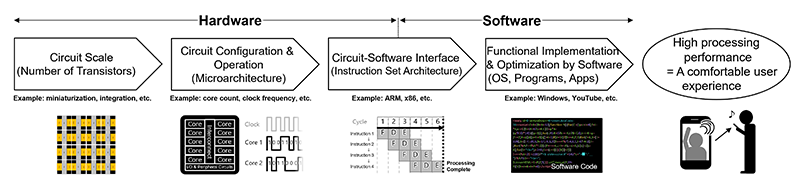
To deliver attractive high-performance convenient experiences to users, processor developers evaluate these factors comprehensively when designing new processors.
For example, comparing a certain old processor model and new one, the transistor count increased by about 1.4 times, yet optimization of various design factors resulted in a 1.6-times improvement in integrated GPU performance.
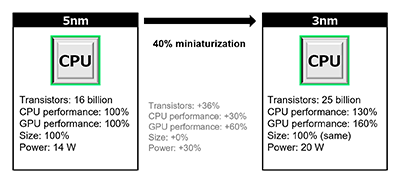
Thus, processor performance continues to improve through the evolution and optimization of various technologies. However, concerns have been raised regarding the continued advancement of device scaling. It is often said that the performance gains achieved through miniaturization have been slowing since the late 2000s, and that as development targets approach process nodes below 1 nm, the physical limits of semiconductor scaling are gradually coming into view.
As a result, processor designers are increasingly pursuing approaches that do not rely solely on further miniaturization to achieve higher performance. Examples include stacking circuits to maintain the pace of transistor growth, dynamically boosting operating frequencies only during periods of intensive processing demand, and incorporating highly efficient compute cores optimized for specific workloads.
Although processor performance is expected to continue improving through both these optimizations beyond scaling and the remaining potential of miniaturization itself, researchers are exploring entirely new computing principles at the same time, that could deliver dramatic performance improvements beyond those achievable with conventional processors. Among them, quantum computing and optical computing breakthroughs are most expected.
3. Processor Applications
Finally, let us take an overview of processor applications.
As mentioned earlier, information terminals like personal computers and smartphones, which give us convenient experiences, are among the useful applications of processors. However, processor applications extend far beyond these devices. Especially, information and communication infrastructure has become an integral part of our daily lives, which processes, stores, and transfers enormous amounts of data from information terminals at high speed. Actually, the infrastructure is the main part that has enabled the evolution of our information society.
Looking back, the volume of data handled by information terminals has grown significantly with the advancement of wireless communication technologies, evolving from voice, text, images, and then to video. At the same time, the global population using information terminals has increased dramatically. To meet the growing demand for data processing from an increasing number of users, information and communication infrastructure has continuously adopted higher performance processors year after year. In particular, cloud data centers, which represent the main part of the information and communication infrastructure, utilize larger numbers of high-performance, high-power processors to compute, store, and transfer vast amounts of data generated by countless users.
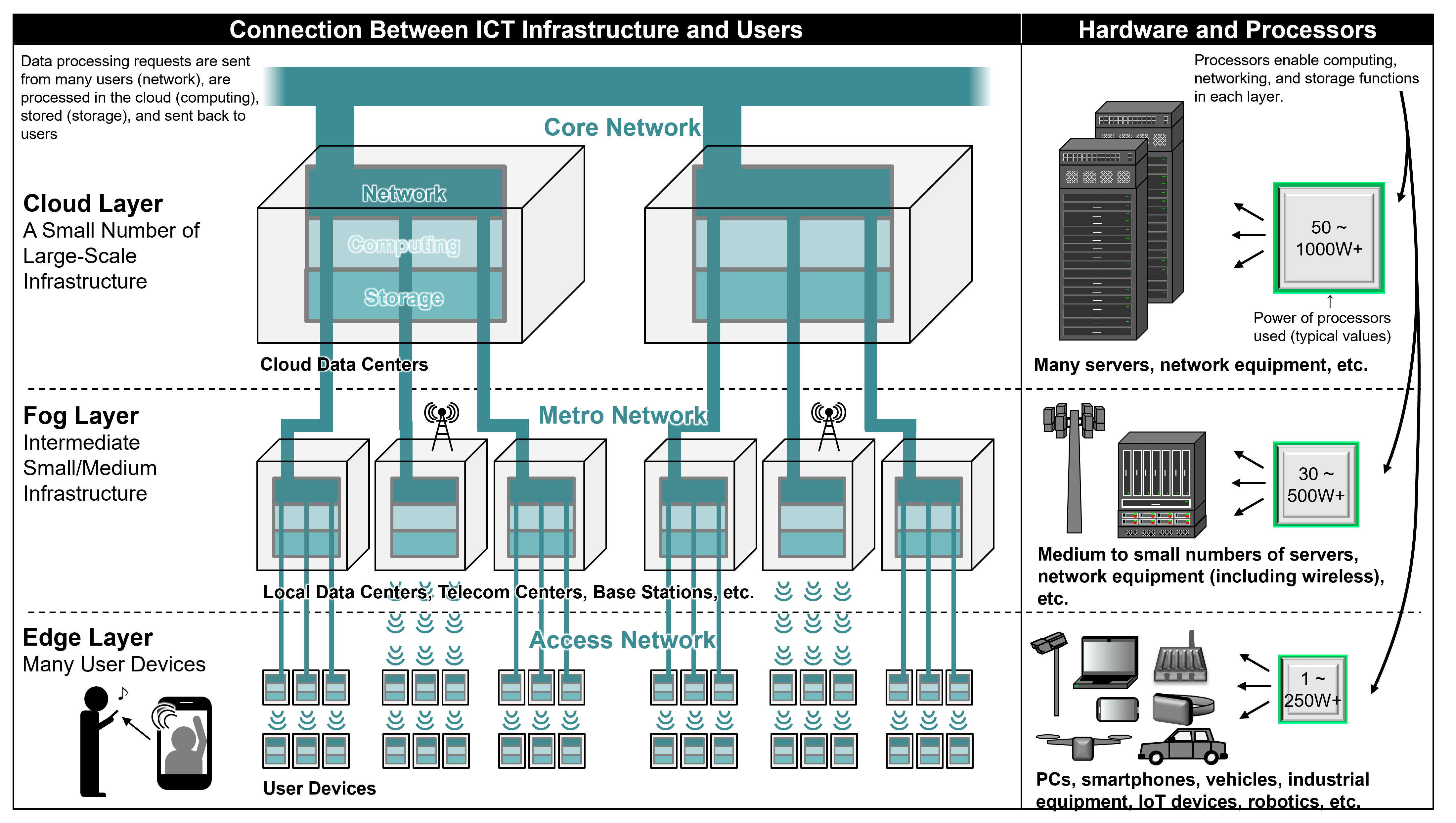
(Information and Communication Infrastructure and User Devices)
Looking toward the latter half of the 2020s, the need for increasingly powerful processors is expected to grow even further. This is because applications such as artificial intelligence (AI), autonomous robots, and autonomous driving systems, which requires advanced data processing, will become widespread in our society for realizing higher quality of life and solving various societal challenges.
Particularly in the field of AI, the increasing practical applications of generative AI have brought unprecedented attention to the processors that determine the main part of application performance. It is frequently reported that AI may eventually surpass human capabilities in a wide range of job fields and significantly influence the future of society, leading to intensified competition among nations in AI-related technologies and development.
Due to such background, demand for processors is expected to continue growing over the long term.

*Reference: Mordor Intelligence Research & Advisory. (2023, July).
Processor Market Size & Share Analysis - Growth Trends & Forecasts (2024 - 2029).
Mordor Intelligence. Retrieved May 24, 2024, from https://www.mordorintelligence.com/industry-reports/processor-market
In this article, we have introduced the fundamentals of processors, including what they are, the factors that contribute to performance improvements, and how processor applications are expanding. In the next article, we will explain the characteristics and use cases of different types of processors, such as CPUs, GPUs, FPGAs, ASICs, and more, and how each is utilized depending on application requirements.
4. Related Articles
- Processor Basics (2) - Types and Usage -
- Processor Basics (3) - Overview and Design of Power Supplies -
- Processor Basics (4) - Key Characteristics Required for Inductors and Capacitors -
- Will Generative AI Drastically Change the World? - The Evolution required for AI Services and the capacitors Supporting Them - (First Part)
- Will Generative AI Drastically Change the World? - The Evolution Required for AI Services and the Capacitors Supporting Them - (Second Part)
5. Tags Related to This Article
 Search by
 Search by
 Search by