What is USB Power Delivery (USB PD)?
-Overview and Market Outlook-
2024-9-25

USB Power Delivery (USB PD), which has been widely used in various devices in recent years, is a standard for power supply based on the USB standard and was created during the process of its evolution. This article provides an overview of the USB PD standard and potential for future market expansion.
1. Overview of the USB and the USB PD Standard
With its high power supply capacity, USB PD is highly versatile by functioning on USB interfaces that can perform high-speed data transfer. This section describes its overview based on its development history.
1-1. Transfer Speed and Connectors
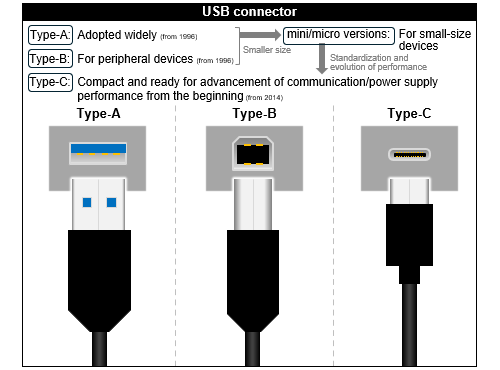
First, let's briefly review the USB, which is the base of USB PD. The Universal Serial Bus (USB) standard was introduced in 1996 as a general-purpose interface for connecting computers and peripheral devices, continuing to be widely used ever since. The USB standard has been revised on a regular basis and USB has become more convenient due to faster data transfer speeds. For example, reading and writing data via USB from a PC to an external storage can now be done with less stress when using USB 3.0, which has a transfer speed of up to 5 Gbps. And with the latest revision USB 4, the speed increased to up to 40 Gbps, which enables external GPUs to be used via USB. Meanwhile, the USB connector shape has also been improved on a regular basis. A particularly significant evolution was the USB Type-C connector, which was standardized in 2014. While it is symmetrical in shape, easy to use, and compact, it can be used across a wide range of applications as standard as it is made to be compatible with future performance evolution. When we look at the share of USB connectors, Type-A is currently the most widely used. However, it is expected to be gradually replaced with Type-C.
| Generation Name | Year of Establishment | Max. Transfer Speed | Connector Shape |
|---|---|---|---|
| USB 1.0-1.1 | 1996~ | 12Mbps | Type A, B |
| USB 2.0 | 2000~ | 480Mbps | Type A, B |
| USB 3.0 USB 3.1 USB 3.2 |
2008~ 2013~ 2017~ |
5Gbps 10Gbps 20Gbps |
Type A, B Type A, C Type C |
| USB 4 | 2019~ | 40Gbps | Type C |
1-2. Power Supply Capacity
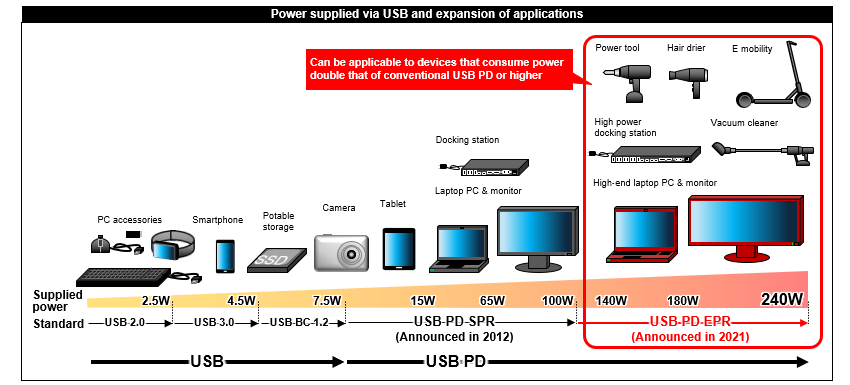
USB has also been able to supply power to connected devices since its release. Its capacity grew to 2.5 W in USB 1.0 and 4.5 W in USB 3.0. As a result of the demand for even greater power supply capacity, the USB Battery Charging (BC) standard was introduced in 2010, in which the capacity increased to 7.5 W, as an optional standard for power supply. And in 2012, the USB Power Delivery (PD) standard was introduced, in which the capacity was increased to a maximum of 100 W. However, as USB PD available in 2012 required a special USB Type-A/Type-B connector, the USB Type-C connector that was introduced in 2014 became the subject of common use of USB PD. With the use of USB PD, monitors that can supply power to laptop PCs with relatively high power consumption were released, unifying power connection and increasing convenience.

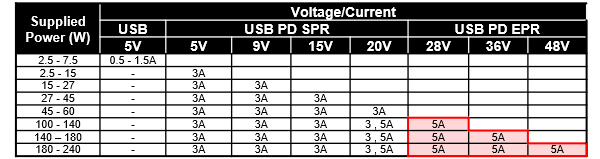
In 2021, the USB PD standard was revised (USB PD 3.1) and the maximum power supply capacity became 240 W. This power expansion was named USB PD Extended Power Range (EPR), and the conventional standard with a maximum of 100 W was distinguished as USB PD Standard Power Range (SPR). The typical power, voltage, and current profiles that SPR and EPR support are shown in the table below. While up to 20 V was used in SPR, operation at higher voltage (28 to 48 V) was added to EPR in order to supply more power.
Note: USB Type-C is not necessarily compatible with USB PD.
Although USB PD is convenient for its ability to provide high power supply, it is important to remember that only some USB Type-C ports are compatible. For this reason, when purchasing a device with the expectation of USB PD, a prior check on the specifications is required. To distinguish by appearance, check the symbol mark near the Type-C port. The USB PD compatibility marks determined by the USB-IF, the organization that manages the USB standard, imitate a battery cell. 
* Only the battery cell-like symbol indicates compatibility with USB PD. Other notations vary depending on the corresponding version and communication speed. Quoted from: USB-IF Logo License | USB-I |
2. Outlook of the USB PD Market
The market for USB PD is expected to expand significantly in the future. There are two main factors in this.
2-1. The Introduction of the USB PD EPR Standard
Even before the introduction of the EPR standard, USB PD had been commonly used to supply power to smartphones, tablets, and PCs that we often use. It was also used in docking stations, which are peripherals responsible for the I/O expansion of these devices. It has been very convenient to use for supplying power to multiple devices simultaneously with its supply capacity of up to 100 W. In the future, with a power supply capacity of up to 240 W based on the EPR standard, convenience is expected to expand even more as high-end gaming laptop PCs, monitors, docking stations, and other devices will be compatible with USB PD. In addition, as a new application brought about by the EPR standard, it is expected to be used in high-output electric and heating equipment that was formerly not applicable due to insufficient power. For example, products such as power tools, cordless vacuum cleaners, E mobility, and hair dryers will be applicable.
2-2. Reduction of Environmental Impact
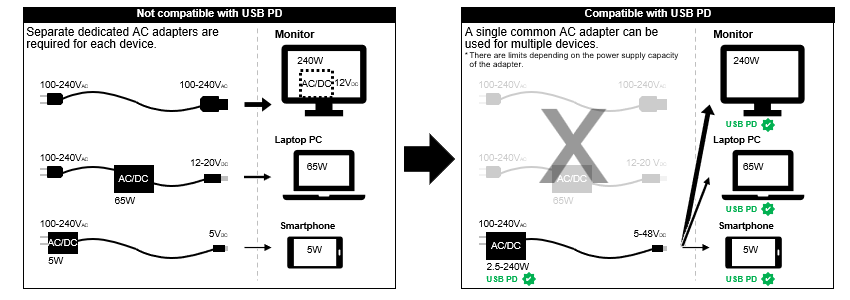
In addition, USB PD is about to be widely used with regards to reducing environmental impact. Conventional devices that are not compatible with USB PD require a dedicated AC adapter for each device. On the other hand, a single AC adapter can be used for multiple USB PD-compatible devices. Therefore, the more compatible devices there are, the greater the effect of reducing environmental impact in terms of resource conservation. In fact, many USB PD-compatible devices available in the market lately do not include an AC adapter as a standard accessory.
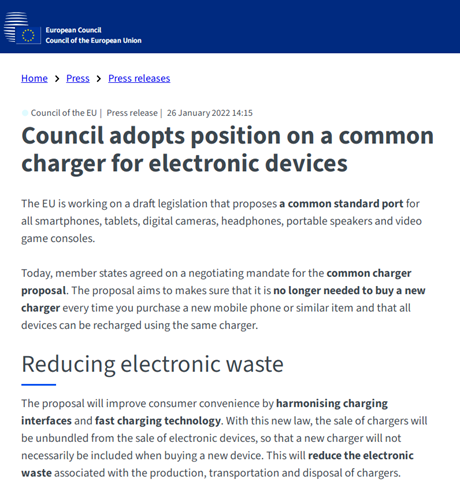
There is also a movement to promote this trend at national level. In October 2022, the European Union (EU) enacted the "Common Charger Directive" mandating the use of USB PD-compatible USB Type-C connectors in portable electronic devices. This mandate began at the end of 2024 at the earliest, covering electronic devices sold in the EU. As many electronic devices are designed with common global specifications, the adoption of USB PD is expected to be accelerated globally. In India, it has already been agreed that a mandate, mostly the same as in Europe, will be applied.

As described above, this article has introduced an overview of the USB PD standard and potential for future market expansion from a marketing perspective.
The next article will focus on the power supply design of USB PD from the perspective of circuit design, and explain the points to consider as well as the selection of the most appropriate capacitor.
3. Related product information
4. Related Information
5. Tags Related to This Article
 Search by Category
 Search by Keyword
 Search by Product
This article covers an overview of USB PD, its market growth potential, and key points for power circuit design and capacitor selection.