
Chip Electrolytic Capacitors (Surface Mount Capacitors)
Definition
Chip electrolytic capacitors are surface‑mount capacitors that use an electrolyte and are soldered onto a printed circuit board (PCB).
In general, they are based on aluminum electrolytic capacitors whose terminals are bent sideways to enable surface mounting. They are commonly distinguished from lead‑type capacitors, which are mounted by inserting terminal leads through holes in the PCB.
In general, they are based on aluminum electrolytic capacitors whose terminals are bent sideways to enable surface mounting. They are commonly distinguished from lead‑type capacitors, which are mounted by inserting terminal leads through holes in the PCB.
Explanation
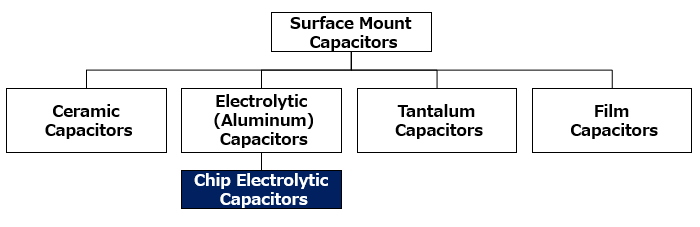
Surface‑mount capacitors can be broadly classified into ceramic, electrolytic (aluminum), tantalum, and film capacitors according to the type of dielectric or electrolyte they use.
Although ceramic capacitors account for the majority of mounted components in terms of quantity, chip electrolytic capacitors are used in applications requiring large capacitance, such as power‑supply smoothing and voltage stabilization. Their role among surface‑mount capacitors is to provide high capacitance while maintaining a compact size.
For more information about the characteristics of each capacitor type and selection guidelines, please refer to “Types of Capacitors and How to Choose Them.”
Although ceramic capacitors account for the majority of mounted components in terms of quantity, chip electrolytic capacitors are used in applications requiring large capacitance, such as power‑supply smoothing and voltage stabilization. Their role among surface‑mount capacitors is to provide high capacitance while maintaining a compact size.
For more information about the characteristics of each capacitor type and selection guidelines, please refer to “Types of Capacitors and How to Choose Them.”
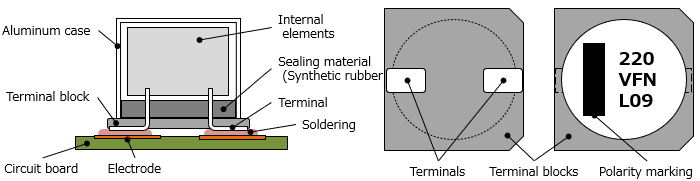
Chip electrolytic capacitors have a structure in which an anode aluminum foil with an oxide film and a cathode aluminum foil are wound together with electrolytic paper, impregnated with electrolyte, and enclosed in an aluminum case.
By mounting the enclosed element on a resin terminal block and extending the terminals horizontally, the capacitor can be placed and mounted directly on the surface of a PCB.
By mounting the enclosed element on a resin terminal block and extending the terminals horizontally, the capacitor can be placed and mounted directly on the surface of a PCB.
Lead‑type components are mounted by inserting their lead wires into PCB holes and soldering them to the board's electrodes, whereas chip electrolytic capacitors have their terminals soldered to electrodes on the board's surface. As a result, surface mounting eliminates the need for drilling holes in the PCB and allows high‑density component placement on both sides of the board. In addition, automated high‑speed mounting improves manufacturing productivity, and the low‑profile design allows these capacitors to fit into thin electronic devices. Conversely, when the same capacitance and rated voltage are required, lead‑type capacitors may offer advantages in terms of dimensions and the range of available options.
There are three points to consider when using chip electrolytic capacitors.
The first is polarity. Chip electrolytic capacitors are polarized components and connecting them with reverse polarity may cause failure.
The second is lifetime. Since the electrolyte gradually evaporates over time, the capacitor has a finite service life. Because higher operating temperatures shorten its lifetime, the intended operating temperature should be carefully considered.
The third point is the reflow soldering temperature. Exceeding the recommended temperature profile may degrade capacitor performance. Therefore, each product should always be used in accordance with its specified conditions.
There are three points to consider when using chip electrolytic capacitors.
The first is polarity. Chip electrolytic capacitors are polarized components and connecting them with reverse polarity may cause failure.
The second is lifetime. Since the electrolyte gradually evaporates over time, the capacitor has a finite service life. Because higher operating temperatures shorten its lifetime, the intended operating temperature should be carefully considered.
The third point is the reflow soldering temperature. Exceeding the recommended temperature profile may degrade capacitor performance. Therefore, each product should always be used in accordance with its specified conditions.