History of Capacitors and How to Select Them (Part 2)
2025-6-25

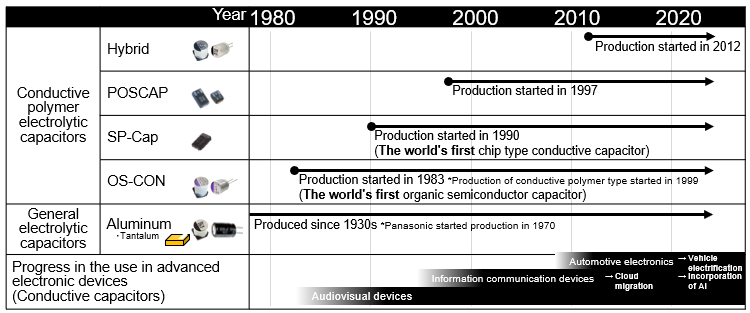
The previous article explained general electrolytic capacitors and conductive polymer electrolytic capacitors sold by Panasonic Industry as well as the history of products up to 2010s while reviewing how they were developed and the background of adopting them in major devices. This article touches on the trends in cutting-edge electronic devices that have supported the evolution of society in the 2020s and explains the basic key points for using our capacitors introduced so far.
1. Direction of Future Evolution of Electronic Devices and Requirements for Capacitors
In response to the demand for advanced devices in each era, Panasonic has developed diversified conductive polymer electrolytic capacitors, which are evolved versions of general electrolytic capacitors, and has expanded the fields where they are used as well as their applications. Looking at the direction of the ongoing evolution of electronic devices in the 2020s, further expansion of AI services is attracting significant attention. Massive data processing has enabled interactions and content generation using AI and development is currently being carried out for the spread of AI that can handle advanced tasks, autonomous robots, and autonomous driving. To achieve these goals, it is expected that high-performance processors will be used even more.
However, the use of electricity will increase in a society where they have been achieved, and concerns about the global environment such as warming are becoming more and more serious. Therefore, as a countermeasure, activities to transition to a society that mainly uses renewable energy are actively being carried out. These activities are carried out to reduce CO2 emissions that lead to degradation of the global environment and realize a sustainable society by building a system that circulates electrical energy between renewable energy power generation facilities, storage batteries, and electric vehicles without using fossil fuels. With this background, initiatives to conserve energy and resources in the individual electronic devices that make up this ecosystem are being carried out more actively, and the use of more efficient power semiconductors (SiC and GaN) and more reliable parts is expanding.
In order to achieve the target performance of electronic devices that support the social evolution of the 2020s, capacitors that meet the requirements for improvements in performance, quality, and size are required as usage environments are becoming more severe. Panasonic has developed conductive polymer electrolytic capacitors that meet the requirements for cutting-edge electronic devices in the 2020s, and will assist in the realization of electronic devices that will support future society.
2. How to Select General Electrolytic Capacitors and Conductive Polymer Electrolytic Capacitors
Now that we looked at the overall historical aspects, we will explain the basic key points of using general electrolytic capacitors and conductive polymer electrolytic capacitors based on the content explained so far.
2-1. Electrical Characteristics and Size
When selecting capacitors, requirements such as electrical characteristics, size, reliability, and cost are comprehensively evaluated, among which electrical characteristics and size are the most important. In order to achieve the performance and size required for the device, capacitors are narrowed down to identify ones that satisfy these requirements. For devices that do not require such high performance or functionality, the electrical characteristics and size required for capacitors are not so strict because the current of the semiconductors to be used is small. Therefore, low-cost general electrolytic capacitors can be used. On the other hand, for devices that require high performance and high functionality, capacitors with low ESR are especially necessary regarding electrical characteristics as the current of semiconductors increases. These requirements are difficult to satisfy with general electrolytic capacitors, so conductive polymer electrolytic capacitors are used.*
*Comparison between the two in 0.x V to 100 V circuits where semiconductors that are sensitive to voltage fluctuations are used. Ceramic capacitors are also used in some cases.
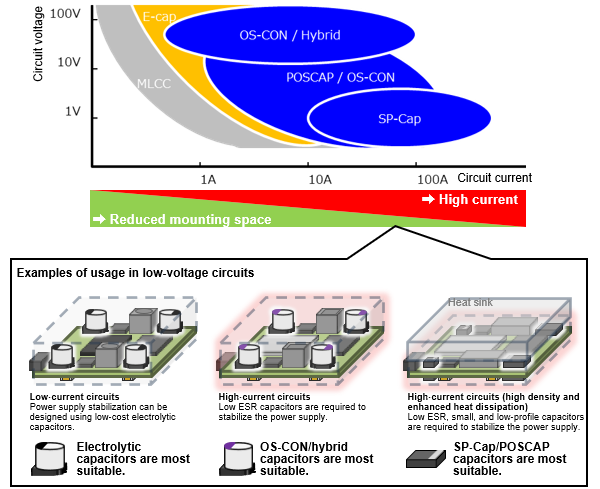
When considering suitable types of conductive polymer electrolytic capacitors to be used in products, OS-CON or hybrid is suitable if there is room in mounting space (area and height) and SP-Cap or POSCAP if there is no room in mounting space. In particular, SP-Cap and POSCAP tend to be used more for cutting-edge high-performance devices with significantly reduced space (area and height) for mounting capacitors as they tend to have many circuits and are required to be small.
The circuit voltage and current range used vary depending on the rating of each product (figure below). Especially in recent years, as the practical use of AI has progressed, processors provide higher performance to implement AI functions not only on data centers but also on information terminals with limited implementation space, increasing the opportunities for the use of conductive polymer electrolytic capacitors.
2-2. Reliability and Cost
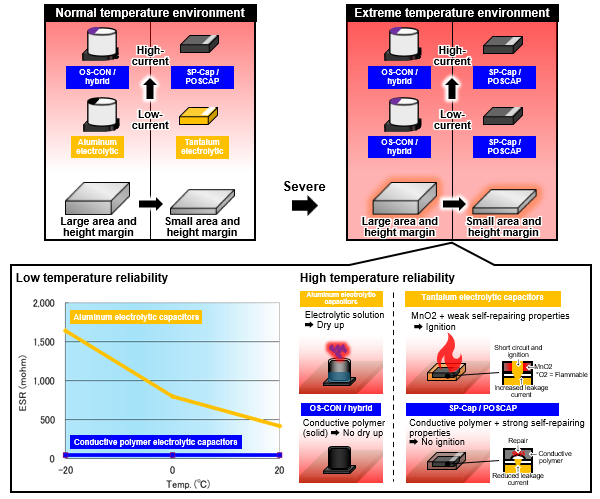
After narrowing down capacitors to ones that satisfy the required electrical characteristics and size, it is necessary to consider capacitors that can satisfy the required reliability and cost. General electrolytic capacitors are the best option in terms of cost as long as they satisfy the requirements for both electrical characteristics and size. However, general electrolytic capacitors may be judged not to satisfy the requirements when there are strict requirements for operating temperature or equipment life for automotive or industrial equipment. In addition, there are cases where general aluminum electrolytic capacitors are avoided due to concerns about failure risks such as leakage and dry-up, and general tantalum electrolytic capacitors are avoided due to concerns about ignition. Conductive polymer electrolytic capacitors are often chosen in such situations. This is because they are more stable than general electrolytic capacitors in terms of temperature characteristics and reliability.
Especially in recent years, cases where conductive polymer electrolytic capacitors are selected are increasing as more capacitors are used outdoors in not only automotive devices but also in IoT and edge computing devices as well as robots. In addition, there is demand for longer-operating information and communications devices due to the increase in sustainability requirements.

2-3. Requirements for Devices and Trends in Capacitor Selection
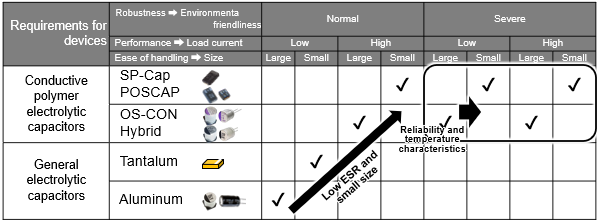
Finally, the table below briefly summarizes the trends in the use of general electrolytic capacitors and conductive polymer electrolytic capacitors. When the requirements for a device are not strict, general electrolytic capacitors are used. For advanced devices with significant requirements, conductive polymer electrolytic capacitors that can satisfy requirements for high current, high reliability, and small size are optimal.
3. Summary
Capacitors have evolved from general electrolytic capacitors to conductive polymer electrolytic capacitors as components that support devices that evolve adapting to the changing times, and various technological evolutions were achieved according to their applications.
Most suitable capacitors can be selected by first narrowing down capacitors by the required electrical characteristics (voltage, electrostatic capacity, ripple current, etc.) and component size, and then taking into account reliability and cost requirements.
Panasonic has a wide range of capacitor products, so we can propose solutions that can satisfy various equipment requirements.
In addition, in order to meet constantly-changing market needs, we will continue to contribute to the evolution of devices through further product development and expansion of our product lineup.
4. Product Information Related to This Article
5. Related Articles
6. Tags Related to This Article
 Search by Category
 Search by Keyword
 Search by Product