What Is USB Power Delivery (USB PD)?
-Design Issues and Selection of Most Appropriate Capacitor-
2024-10-25

The previous article introduced an overview of the USB PD standard and potential for market expansion in the future. This article focuses on the power supply circuit design in USB PD, and explains points to consider and how to select the most appropriate capacitor.
1. Design Issues Regarding USB PD Compatibility
This section focuses on power supply circuit design regarding USB PD, and explains the issues to consider as well as the contribution of capacitors. For USB PD to function, an AC/DC converter that supports flexible power supply from a commercial power supply to each device as well as a DC/DC converter that supports receiving power from it and supplying power to other devices. Let's take a look at each item.

1-1. AC/DC Converter
As described earlier, one of the advantages of USB PD is that a single AC adapter can be used to supply power to multiple devices. However, you need to choose an AC adapter with sufficient power supply capacity.

The problem here is "size." The level of power supply capacity is proportional to the size of the AC adapter. For example, a 100 W AC adapter is extremely large and heavy. However, this issue has been resolved in recent years. The size can now be reduced by using GaN semiconductors as switching elements of AC/DC converters. The number of smaller size AC adapters using GaN is increasing year by year, and some products are more than 50% smaller than conventional products. Smaller adapters can be made using GaN because GaN has less switching losses compared to conventional Si. Less switching losses result in less heat generation. In addition, even if the switching frequency is set to a higher value, the conventional level of heat generation can be maintained. As a result, the size of heat dissipation components and passive components can be reduced, enabling smaller AC adapters. In this process, the size can be reduced more effectively by using polymer capacitors. Please refer to the following article for details.

1-2. DC/DC Converter
In USB PD-compatible devices, there is a change in the power supply circuit on the receiving side of the device that receives power from the AC adapter. For example, in conventional chargeable cordless vacuum cleaners, the output voltage of the AC adapter was fixed at the optimal voltage for charging the battery. However, in uses compatible with USB PD, an AC adapter with various output voltages is connected to USB PD ports as mentioned above. Naturally, these voltages do not match the allowable charging voltage of the battery. Therefore, an additional DC/DC converter is added between the USB PD port and the battery in order to adjust the receiving voltage* that the device receives to the charging voltage that the battery requires.
* The receiving voltage is not necessarily the maximum output voltage of the AC adapter, but is selected by the USB PD controller on the device side.

However, one issue arises here. For devices that require the addition of a DC/DC converter to be compatible with USB PD, the available mounting space is not always sufficient to maintain the specified device size. The same problem is expected to occur on devices that are already compatible with USB PD when adopting higher-power USB PD EPR.

In this case, the preferred solution is to keep the size of the DC/DC converter as small as possible. In order to select the most appropriate capacitor for miniaturization, let's first look at the relationship between the operation of the DC/DC converter used in USB PD and the capacitor.
- Switching ripple current
When a DC/DC converter is used, its switching operation generates ripple current at its input and output. This ripple current must be absorbed near the DC/DC converter so that it does not propagate to the surrounding circuits. The capacitor is responsible for absorbing (smoothing) this ripple current. - Load change current
A current fluctuation occurs in addition to the ripple current. It is due to the circuits before and after the DC/DC converter. In a system circuit after the DC/DC converter, significant current fluctuations occur due to changes in operating loads, depending on the application. If these fluctuations occur at a high speed, the current supply from the DC/DC converter or battery cannot follow it. The capacitor plays a role in backing up the required current in this situation. Also, when supplying power from a USB port to an external device, a backup from the capacitor may be required momentarily for the same reason.


So, what is the most appropriate capacitor to achieve a compact design against these current fluctuations?
For the purpose of smoothening ripple currents, MLCC is a common choice. As DC/DC converter switching occurs at hundreds of k to several MHz, MLCC with low impedance and ESR in this region, small size, and high current tolerance is effective. However, it is important to note that acoustic noise may be generated when large ripple currents flow at low frequencies in the audible region during intermittent operation of the DC/DC converter under light loads. The acoustic noise is generated by the vibration of the substrate due to the expansion and contraction caused by the inverse piezoelectric effect which is unique to MLCCs. If the acoustic noise needs to be suppressed, there are measures such as combining a polymer capacitor that does not generate acoustic noise and a small MLCC that is less likely to cause acoustic noise.

For current backup purposes, polymer capacitors are commonly used. This is because load change currents are generated at lower frequencies than the switching ripple current and have a larger amplitude, requiring a large-capacitance capacitor. There are small and large-capacitance MLCCs based on ratings alone. However, due to their bias characteristic where the capacitance significantly reduces depending on the applied voltage, a large number of products are required in actual use, occupying large areas. Also, if you try to optimize the number of capacitors, you need to fully validate this characteristic change. On the other hand, when polymer capacitors are used, the capacitance does not change due to the applied voltage, and large capacitance can be obtained stably. As a result, they can be a solution to achieve smaller sizes with less effort.


So, what type of polymer capacitors are most suitable for miniaturization?
When focusing on the shape of polymer capacitors, there are can type and molded type products. When the size needs to be reduced as much as possible, molded type products are the best choice. The shortest can type capacitors are 5 to 6 mm high (depending on the rating) and their product lineup is limited. On the other hand, there is a wide selection of small size, large capacitance, molded type capacitors with a height of 4 mm or less. As products with a height of 2 mm or less are commonly available, they can be mounted on both sides of the substrate, providing a higher capacity density than can type products.

When we look at polymer capacitors from the perspective of dielectric materials, there are aluminum and tantalum types. This is also one of the factors related to miniaturization. Tantalum type provides a higher dielectric constant, and is superior in terms of small size and large capacitance in many cases. Panasonic Industry's conductive polymer tantalum solid capacitors (POSCAP) are capacitors that achieve both small size and large capacitance by using molded shapes and tantalum dielectrics. The capacity density of POSCAP has been continuously improved by miniaturizing tantalum powder and improving its structure, and the product lineup for 35 V rating capacitors with larger capacitance has been expanded (35TQT56M, 35TQS68ME2). These products will contribute to solving footprint issues in USB PD EPR 28V applications that have begun to be introduced.

2. Examples of Use in IC Manufacturers' Reference Boards
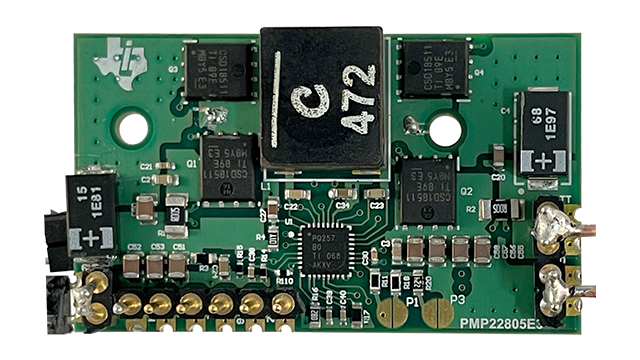
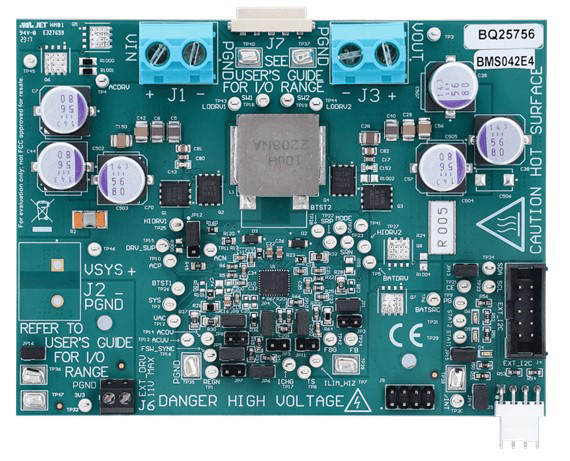
Panasonic Industry's polymer capacitors POSCAP and OS-CON are used in reference boards of Texas Instruments, a leading provider of power supply ICs for USB PD.
- 【Summary Specifications】
- Input: 5 to 24V, Output: 15 to 21V, 10A (240W)
- 【Power Supply IC】
- BQ25731 (USB Type-C PD support, I2C, 1 to 5 cell, NVDC buck-boost battery charge controller)
- 【Applications】
- Various battery-powered devices, power tools, power banks, etc.
- 【Capacitors】
- Conductive Polymer Tantalum Solid Capacitors (POSCAP)
25TQC68MYF (25V, 68uF, 70mΩ, 7.3x4.3xH2.8mm)
→ 25TQC68MD3 (Replacement part number )
25TQC15MYFD (25V, 15uF, 90mΩ, 7.3x4.3xH1.9mm)
→25TQC15MD2 (Replacement part number )
- 【Specifications】
- Input 4.2 to 55V, Output 3.3 to 55V 10A (400W)
- 【Power Supply IC】
- BQ25756 (70V, Bidirectional, Buck-Boost Charge Controller with MPPT, Standalone or I²C Control)
- 【Applications】
- Power tools, power banks, e-bikes, cordless vacuum cleaners, robotic vacuums, solar chargers, and other USB PD EPR applications
- 【Capacitor Used】
- Conductive Polymer Aluminum Solid Capacitors (OS-CON)
80SXV56M (80V, 56uF, 28mΩ, φ10xH12.6mm)
3. Summary
In addition to these products, Panasonic Industry has a wide range of polymer capacitors that are useful for USB PD designs. We will continue to expand our products to meet market needs and support the spread of USB PD.

4. Product Information Related to This Article
5. Related Articles
6. Tags Related to This Article
 Search by Category
 Search by Keyword
 Search by Product
This article covers an overview of USB PD, its market growth potential, and key points for power circuit design and capacitor selection.